


Financial Insights | Industry KPI Guide Series Vol. 7
The bottom line:
The two KPIs to look at first in real estate are Occupancy Rate and NOI (Net Operating Income).
Even when rental income looks strong on paper, revenue can fall as vacancies increase, and higher management and maintenance costs can quickly eat into profits.
Occupancy Rate shows what is happening at the front end of the revenue cycle — whether units are being filled or left vacant. NOI shows how much income the property generates after operating expenses are deducted.
For properties financed with debt, DSCR (Debt Service Coverage Ratio) should also be reviewed alongside NOI. Looking at a property through the lens of NOI rather than rental income alone is the first step toward understanding its true operating performance.
Why Rental Income Alone Does Not Tell the Whole Story
The business model of real estate rentals may seem straightforward: own a property, lease it to tenants, and collect rent.
In practice, however, the amount of profit left over can vary significantly even when rental income is similar. Differences in vacancy rates and operating costs can have a major impact on the bottom line.
A property with near-full occupancy may still generate relatively little profit if operating costs are high. Conversely, a property with somewhat lower occupancy can still produce solid returns if it is operated efficiently.
Real estate investments also often involve debt financing. Even when a property generates sufficient operating income, heavy debt-service obligations can put pressure on cash flow. That is why it is important to look beyond NOI and also monitor DSCR, which indicates how much capacity a property has to cover its debt payments.
Rather than focusing only on the headline figure of rental income, property owners need to continuously monitor KPIs that capture both profitability and cash-flow strength, including occupancy rate, operating expense ratio, NOI, and DSCR.
The Real Estate Rental Lifecycle and Its Key KPIs
The economics of a rental property build through a sequence:
Leasing & Occupancy ➜ Rent & Operating Costs ➜ Profitability & Investment Returns ➜ Financial Strength
A problem at one stage can affect everything that follows. That is why effective property management is not about looking at individual KPIs in isolation. The goal is to identify bottlenecks across the entire flow.
Higher vacancies (lower occupancy) ➜ Lower rental income & greater cost burden ➜ Lower NOI & weaker debt-service capacity
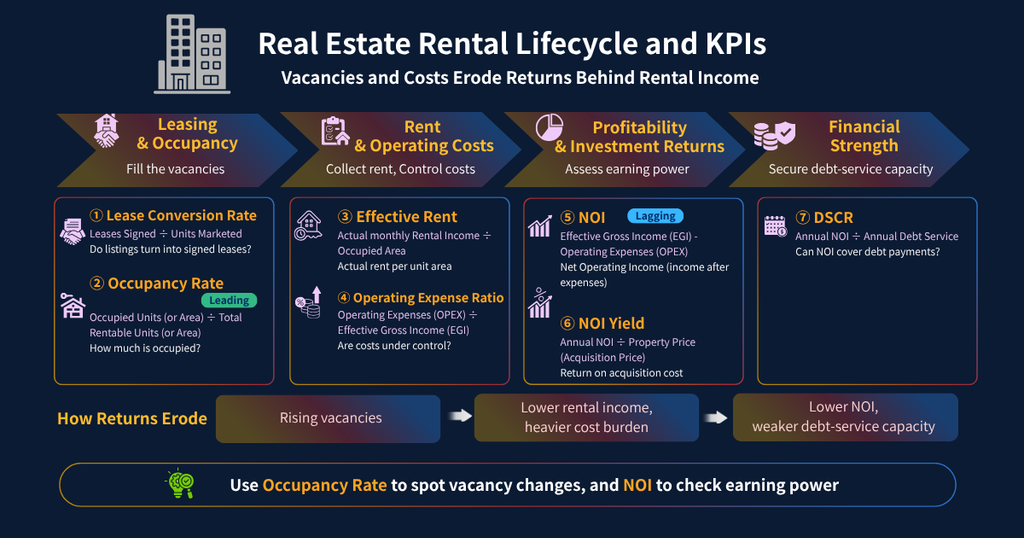
7 Key KPIs for the Real Estate Industry
| Phase | KPI | Formula | What to Look For* |
|---|---|---|---|
| Leasing & Occupancy | Lease Conversion Rate | Leases Signed ÷ Units Marketed | Varies by location and property type |
| Leasing & Occupancy | Occupancy Rate (Vacancy Rate) | Occupied Units (or Area) ÷ Total Rentable Units (or Area) | Compare with similar properties and historical performance |
| Rent & Operating Costs | Effective Rent | Actual Rental Income ÷ Occupied Area (monthly) | Evaluate after free-rent periods and discounts |
| Rent & Operating Costs | Operating Expense Ratio (OPEX Ratio) | Operating Expenses (OPEX) ÷ Effective Gross Income (EGI) | Typically around 20–30% |
| Profitability & Investment Returns | NOI (Net Operating Income) | Effective Gross Income (EGI) − Operating Expenses (OPEX) | Compare with prior year and budget |
| Profitability & Investment Returns | NOI Yield | Annual NOI ÷ Property Price (Acquisition Price) | Compare with similar properties |
| Financial Strength | DSCR (Debt Service Coverage Ratio) | Annual NOI ÷ Annual Debt Service | Below 1.0x: NOI cannot cover debt service; lenders often look for 1.2–1.3x or higher |
① Lease Conversion Rate | How Much of Your Leasing Activity Turns into Revenue?
Lease Conversion Rate = Leases Signed ÷ Units MarketedThis KPI measures how effectively leasing activity turns into signed contracts.
A low conversion rate may indicate that asking rents are out of line with the local market, the property is not being presented effectively, or the brokerage and leasing channels are not generating enough qualified prospects.
Compare the rate with the previous month, the same period last year, and the budget. Breaking the data down by location and property type can also help identify the underlying cause.
② Occupancy Rate (Vacancy Rate) | How Much of the Property Is Actually Being Used?
Occupancy Rate = Occupied Units (or Area) ÷ Total Rentable Units (or Area)
Vacancy Rate = 1 − Occupancy Rate
Occupancy rate is one of the most fundamental KPIs in the rental property business.
Even when units are vacant, fixed costs and debt payments continue. As a result, a decline in occupancy can quickly translate into weaker profitability.
That said, high occupancy does not always mean high profitability. Frequent move-ins and move-outs can increase turnover costs, including restoration work and leasing expenses, reducing the property’s effective profitability.
For that reason, it is also important to monitor the number of move-ins and move-outs and the average tenant stay.
③ Effective Rent | What Rent Are You Actually Collecting?
Effective Rent per Square Meter (monthly) = Actual Rental Income ÷ Occupied Area
Effective Rent per Unit = Actual Rental Income ÷ Occupied Units
The advertised rent and the effective rent can be very different once free-rent periods and discounts are taken into account.
In highly competitive markets, landlords may keep the advertised rent unchanged while offering concessions to close the deal. Looking only at the headline rent can therefore give a misleading picture of the property’s earning power.
④ Operating Expense Ratio (OPEX Ratio) | Are Operating Costs Under Control?
Operating Expense Ratio = Operating Expenses (OPEX) ÷ Effective Gross Income (EGI)
Effective Gross Income (EGI) = Gross Potential Rent − Vacancy Loss + Other Income
The operating expense ratio measures how much it costs to operate a property relative to the income it generates.
As a property ages, maintenance and repair costs tend to increase, which can push the operating expense ratio higher. If the ratio is significantly above comparable properties, there may be opportunities to improve efficiency by reviewing the management structure or the property management company.
Major capital expenditures (CAPEX), such as large-scale renovations, are generally not included in NOI. Instead, they are considered separately when assessing cash flow after NOI.
⑤ NOI | A Core Measure of Property-Level Profitability
NOI = Effective Gross Income (EGI) − Operating Expenses (OPEX)NOI (Net Operating Income) is a key measure of a property’s underlying earning power. It serves as the basis for major investment and lending metrics such as NOI yield and DSCR.
The important point is that NOI measures the property’s operating profitability before expenses such as depreciation and interest on borrowings are deducted.
⑥ NOI Yield | How Much Does the Property Earn Relative to Its Investment Cost?
NOI Yield = Annual NOI ÷ Property Price (Acquisition Price)NOI yield is one of the most commonly used measures of real estate investment performance.
Even with the same NOI, a higher acquisition price results in a lower yield, while a property acquired at a lower price produces a higher yield.
The appropriate level varies significantly depending on the location, property use, age, purchase price, and future income outlook. Rather than evaluating NOI yield in isolation, it is important to compare it with transaction prices and market yields for similar properties.
⑦ DSCR | Does the Property Generate Enough to Service Its Debt?
DSCR = Annual NOI ÷ Annual Debt ServiceDSCR (Debt Service Coverage Ratio) shows how many times the property’s NOI covers its annual debt service, including both principal and interest.
A DSCR below 1.0 means that NOI alone is not sufficient to cover the property’s debt payments. It is therefore an important metric used both in lending decisions and in ongoing financial management after a loan has been made.
Warning Signals: Reading Business Risks Through KPI Changes
| KPI | Warning Signal | Business Risks | First Action |
|---|---|---|---|
| Lease Conversion Rate | Declines YoY for 2 consecutive months | Mismatch between leasing conditions and market demand | Compare rents with the local market; review property presentation and leasing channels |
| Occupancy Rate | Remains below 85% | Lower rental income and weaker NOI | Review rent levels, leasing channels, and the property’s appeal |
| Effective Rent | Growing gap from advertised rent | Deterioration in actual rental pricing | Compare with competing properties and consider property upgrades |
| Operating Expense Ratio | Above 30% and high relative to comparable properties | Pressure on NOI | Review the management structure, property management provider, and maintenance plan |
| NOI | Declines YoY for 3 consecutive months | Weaker debt-service capacity and lower property valuation | Break down the change into occupancy, effective rent, and operating expenses |
| NOI Yield | Remains below the acquisition assumptions | Deteriorating investment economics | Review rent strategy and consider value-add investments |
| DSCR | Below 1.2x | Weaker debt-service capacity | Review financing terms and identify ways to improve cash flow |
How to Conduct a KPI Review
Step 1: Start with the results
Compare occupancy, effective rent, and NOI with the previous month, the same period last year, and the budget to understand where the property stands.
Step 2: Identify the drivers
Break changes in occupancy down into new leases, move-outs, and lease conversion rates to determine whether changes in profitability are being driven by leasing volume or pricing.
Step 3: Assess Profitability and Financial Health
Use the operating expense ratio to understand the cost structure, then evaluate investment performance and financial strength using NOI yield and DSCR.
Step 4: Decide on actions
Turn the findings into specific actions — such as revising the rent strategy, reviewing the property management structure, or renegotiating financing terms — and make it clear who will do what and by when.
Summary
Real estate rental KPIs are connected through one fundamental process:
maintain occupancy, control operating costs, and maximize NOI.
Looking only at headline rental income, a lagging indicator, can hide structural problems such as lost revenue from vacancies, rising operating costs, and heavy debt-service obligations.
By monitoring occupancy, operating expenses, NOI, and DSCR together, property owners can develop a more complete picture of both property profitability and financial capacity.
Here are the seven KPIs covered in this article:
| Phase | KPI | Key Points to Check | Impact on Management |
|---|---|---|---|
| Leasing & Occupancy | Lease Conversion Rate | Are leasing activities turning into signed contracts? | Leasing efficiency |
| Leasing & Occupancy | Occupancy Rate (Vacancy Rate) | How much of the property is occupied? | Revenue foundation |
| Rent & Operating Costs | Effective Rent | What rent is actually being collected? | Revenue structure |
| Rent & Operating Costs | Operating Expense Ratio | Are operating costs reasonable relative to income? | Profitability |
| Profitability & Investment Returns | NOI | How much income remains after operating expenses? | Starting point for investment evaluation |
| Profitability & Investment Returns | NOI Yield | How much does the property earn relative to its investment cost? | Asset value and exit decisions |
| Financial Strength | DSCR | Can the property cover its debt service payments? | Cash flow and financing sustainability |
The purpose of KPI management in real estate rentals is to assess the profitability and financial capacity of each property from three angles — occupancy, operating costs, and debt service — and identify which properties require attention first.
Frequently Asked Questions
1. What are the most important KPIs in real estate?
Occupancy rate and NOI.
Occupancy rate is an important leading indicator because it shows changes in vacancy at the front end of the revenue cycle. NOI is a key outcome measure because it shows the property’s earning power after operating expenses.
2. What is the difference between occupancy rate and vacancy rate?
Occupancy rate is the percentage of rentable units or space that is actually occupied. Vacancy rate is the percentage that remains unoccupied.
They are essentially two sides of the same measure:
Occupancy Rate + Vacancy Rate = 100%
3. What is a good NOI yield?
There is no single benchmark that applies to every property.
NOI yield varies significantly depending on the location, property use, building age, property price, and future income outlook. It is more meaningful to compare the yield with similar property transactions, prevailing market levels, and the assumptions used when the property was acquired.
4. What is DSCR, and why does it matter?
DSCR measures how many times a property’s NOI covers its annual debt service.
A DSCR below 1.0 means that NOI is not sufficient to cover the property’s debt payments. It is an important metric used in both lending decisions and ongoing financial management, although the required level varies by lender and transaction.
5. What is the difference between rental income and NOI?
Rental income is the revenue collected from tenants.
NOI is what remains after operating expenses are deducted from the property’s effective gross income.
Because vacancy rates and operating costs can have a significant impact on NOI, NOI is a more useful measure than rental income alone when evaluating a property’s underlying earning power.
Next Article
Financial Insights | Industry KPI Guide Series Vol. 8
Wholesale KPIs: 7 Key Metrics, Starting with Slow-Moving Inventory, Overdue Receivables, and CCC