


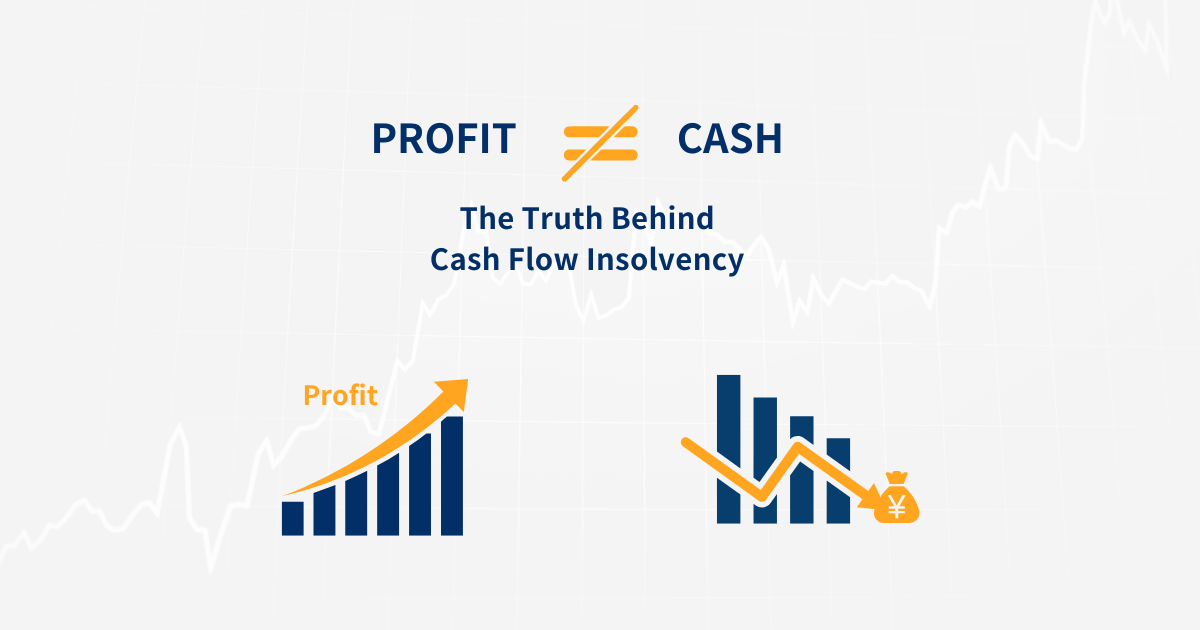
Record-high sales.
Strong profitability.
Yet the bank balance at month-end feels uncomfortably low.
Many business owners have experienced this moment — and it often signals a deeper financial risk.
“Profit means we’re safe.”
This is one of the most dangerous assumptions in management.
In reality, a company can be profitable on paper and still run out of cash.
This is the essence of cash flow insolvency, commonly known as going bankrupt while profitable.
From a finance professional’s perspective:
“Profit can be manipulated. Cash cannot.”
The gap between accounting profit and actual cash is what puts companies in danger.
Profit and Cash Don’t Move Together
Cash flow insolvency occurs when a business shows positive net income but lacks the cash needed to pay suppliers, salaries, or debt.
- Profit = an accounting result (a promise)
- Cash = money you can actually use (a fact)
Ignoring this gap is what turns a healthy business into a vulnerable one.
Example: ¥10M in Sales but ¥8M Negative Cash
- Revenue: ¥10,000,000
- Profit margin: 20% (profit ¥2,000,000)
- Customer payment: two months later
- Outsourcing / purchases: ¥8,000,000 (paid this month)
On paper, the company shows ¥2M in profit.
But in reality, it must pay ¥8M this month.
This means: Cash balance at month-end: –¥8,000,000
If the company cannot bridge this gap for two months until payment arrives, it becomes insolvent despite being profitable.
This is the true meaning of “Profit exists, but cash does not.”
Why Profitable Companies Still Go Bankrupt (4 Structural Reasons)
1. Slow or Delayed Collections
Revenue is recorded today, but cash arrives later.
When accounts receivable accumulate, a company may be profitable but unable to pay its bills.
In Japan, payment terms like “end of month, paid next month or the month after” make this even more common.
2. Inventory Consumes Cash
Inventory is an asset, but it is simply cash converted into goods.
If inventory grows faster than sales, cash tightens even when the P/L looks healthy.
Manufacturing, EC, and retail businesses are especially affected.
3. Upfront Payments vs. Long Payment Cycles
・Suppliers require upfront payments
・Customers pay later
This structural mismatch causes cash shortages long before profitability becomes an issue.
4. Rapid Growth Without Cash Planning
Growth requires cash — for hiring, inventory, equipment, and operations.
Many companies fall into the “growth trap” — sales increase, but cash decreases.
The Real Danger: Cash Disappears Suddenly
Profit declines gradually.
Cash declines instantly.
・Payment delays
・Payroll pressure
・Emergency borrowing
・Supplier trust deteriorates
・Operations freeze
By the time the issue becomes visible, the company may already be in crisis.
How to Prevent Cash Flow Insolvency
1. Build a 13-Week Rolling Cash Flow Forecast
A weekly-updated 13-week rolling forecast helps identify cash shortages early.
2. Monitor Working Capital weekly
Track receivables, payables, and inventory weekly.
Weekly monitoring provides a far more accurate picture than monthly reporting.
3. Align Payment Terms
・Negotiate supplier terms
・Accelerate customer billing
・Introduce deposits or upfront payments
Improving the cash cycle dramatically reduces cash stress.
4. Visualize Cash Drivers
Power BI dashboards reveal patterns that EXCEL spreadsheets cannot:
・AR aging
・Inventory buildup
・Payment cycle mismatches
・Seasonal cash patterns
Visualization improves decision-making quality.
5. Strengthen Internal Processes (Automation)
Automate:
・Invoicing
・Payment reminders
・Approvals
・Cash tracking
Automation reduces delays, errors, and dependency on individuals.
The Role of Finance Teams Today
Modern finance is not just about bookkeeping.
It’s about building systems that protect the company from avoidable risks.
- Structure financial data
- Visualize trends
- Automate workflows
When these foundations exist, cash shortages can be prevented before they occur.
About FinStepX
At FinStepX, our mission is to turn finance into a strategic advantage for small and mid-sized companies.
We support clients by building financial systems that enable confident decision-making:
- Financial KPI design
- Cash flow forecasting and liquidity improvement
- Power BI dashboards for visibility
- Power Automate workflows for invoicing, approvals, and cash operations
Our focus is not just analysis — but building mechanisms that protect cash.
Free Online Consultation
If you’re facing challenges like:
- “We’re profitable, but cash is always tight.”
- “Our financial data is scattered and hard to use.”
FinStepX offers a free online consultation to help you:
- Identify your current financial pain points
- Explore practical ways to improve cash flow
- See how dashboard and automation can simplify your finance operations
Conclusion
Many profitable companies go bankrupt — not because the business is weak, but because cash is not managed with the same rigor as profit.
FinStepX helps transform profit into stable, sustainable cash flow through visibility, structure, and automation.
From being overwhelmed by numbers to using numbers as a strategic weapon — let’s build a stronger financial future together.
For inquiries, contact us anytime at inquiry@finstepx.com.
FAQ:Common Questions About Cash Flow Insolvency
Many business leaders share similar concerns when it comes to cash flow insolvency.
Below are the most frequently asked questions, explained in a practical and actionable way.
These answers will help you strengthen your cash visibility and make more confident financial decisions.
Q1. What is cash flow insolvency?
Cash flow insolvency occurs when a company is profitable on paper but lacks the cash needed to pay its obligations on time.
Q2. Why do profitable companies still run out of cash?
Profit and cash flow follow different rules. Delayed receivables, inventory buildup, upfront payments, and rapid growth can all drain cash even when profits look healthy.
Q3. How can businesses prevent cash flow insolvency?
By forecasting cash flow, monitoring working capital weekly, aligning payment terms, and visualizing key cash drivers to support timely decisions.
Q4. What tools help improve cash visibility?
Cash flow dashboards, rolling forecasts, and automated financial processes provide real‑time insight and reduce the risk of sudden liquidity issues.
Comments